Saturday, 10 August 2013

HD 189773b: The Blue Planet that Rains Glass

Illustration of HD 189733b
HD 189773b
The planet named as HD 189773b looks cosy and Earth-like. Doesn't it? However, you would not like to live there. Firstly, the surface temperature there is 1,000°C (1,832°F) and secondly, it rains glass, sideways, at the speed of 4000 mph.

In space terms, this planet not far from Earth. It is actually a mere 63 light years (370,353,398,510,567 miles) away . So that is why Hubble and other telescopes that are orbiting Earth can see it in so much details. On October 5th 2005, an astronomer in France found this planet orbiting the star HD 189733a (note that our sun is also a star). It orbits the star at a speed of 341,000 mph (549,000 kph). In comparison, our Earth's average orbiting speed is 67,000mph(107,200 kph). This planet has a mass that is 13% more than the mass of Jupiter (which is the largest planet in our solar system and is made of gas). This makes it a hot Jupiter (which means it is a hot gas planet about the same size of Jupiter) and destroy almost all prospects of extra-terrestrial life. Every year on HD 189773b is equivalent to 2.2 Earth days because it orbits its star very closely.

A graph of the visible-light colours of planets 
including HD 189733b
On March 2010 it was found out that this planet is evaporating at a rate of 1,000,000,000 to 100,000,000,000 grams every second. In July (which, by the way is the month I was born in :-)) this year, NASA also found out that this planet blocks three times more X-rays than visible light.  

The blue colour of the planet is thought to have come from silicate particles which scatter blue lights. These particles, which are found in the planets atmosphere, then condense into glass due to very hgih temperature. That is why it rains glass.

Conclusion: It is very unusual to find a planet like this. However there is not a lot of interesting stuff about this planet because no extra-terrestrial life can survive there. I give it a 7/10


Image Credit:


HD 189773b: http://commons.wikimedia.org/wiki/File%3AHD_189733_b_deep_blue_dot.jpg: 
By NASA, ESA, M. Kornmesser [Public domain], via Wikimedia Commons

Visible-light Colours of Planets: The colour of HD 189733b compared to our Solar system. Credit: NASA [This file is in public domain because it was solely created by NASA. NASA copyright states that "NASA material is not pretected by copyright unless stated"

Sunday, 21 July 2013

Europa: A Possible Source of Extraterrestrial (ET) life?

In our Solar system, the planet Jupiter has 67 moons. Europa is one of those 67 moons. It is the sixth largest moon in the Solar System. It was discovered by Galileo Galilei in 1610. But what most people do not know was that Europa was possibly discovered by Simon Marius, a German astronomer, around the same time that Galileo discovered it. At that time people thought that it was just an insignificant and tiny dot in the sky, but recent studies suggest that Europa might be a potential harbour for life.
Europa

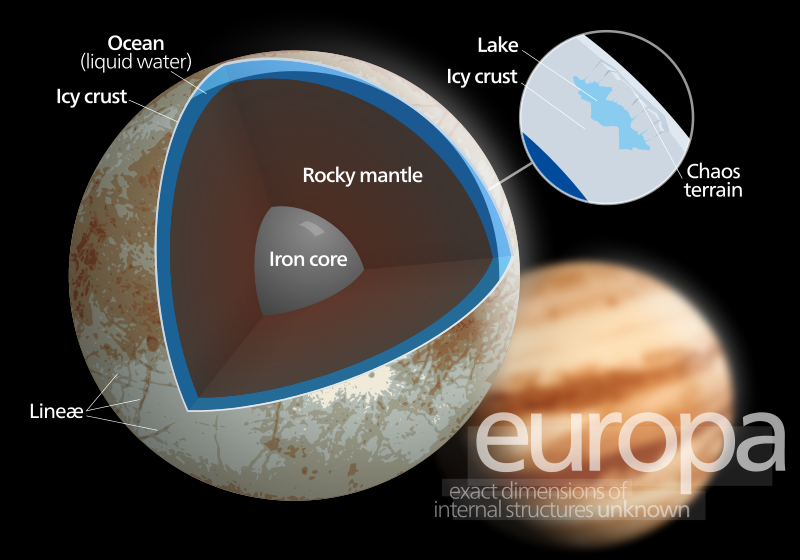
There is an ocean with liquid water beneath the icy crust! The reason? Tidal flexing which cause the ice to melt into water. What is tidal flexing? Well, it is hard to explain so click here to read an article about it. Anyway, scientists believe that life there could be similar to life found in the deep ocean (that region it also called the Hadalpelagic zone) on Earth.

The internal structure of Europa with Jupiter in the background
Now, if your looking at the labels of this blog post you may be wondering what bullets have got to do with Europa. Well, researchers at University College London  have designed a 19.6 kg bullet that is loaded with scientific equipments such as seismograph to measure tremors and a miniature chemistry lab to study the ice and the water beneath it. This giant missile could smash through the icy crust of Europa. This could be deployed around 2023 and it could answer one of the greatest mysteries in our solar system: Is there life on Europa (and if the answer is yes, whether it likes getting shot at by a giant bullet).

Conclusion: Europa is a very exciting natural satellite (moon) and I love the simplicity the research plan. I think if there is life up there then it would look very familiar to tube worms and other deep sea creatures. For this innovative method and awesomeness at the prospect of finding extraterrestrial life that is so close to our planet, I give this research and Europa a 10/10.

Image credits:

Europa: Wikimedia Commons: http://commons.wikimedia.org/wiki/File:Europa-moon.jpg 
The internal structure of Europa with Jupiter in the background:By Kelvinsong (Own work) [CC-BY-SA-3.0 (http://creativecommons.org/licenses/by-sa/3.0)], via Wikimedia Commons: http://commons.wikimedia.org/wiki/File%3AEuropa_poster.svg


Sunday, 23 June 2013

The late heavy bombardment: an important source of life on the Earth?

An artists impression of our moon during
and after the late heavy bombardment
You might wonder how comes there are so many craters on the planets and moons. Scientists say that this is due to the late heavy bombardment which is an hypothetical event that happened around 3.8 to 4.1 billion years ago. During this event a large number of comets and meteoroids would have collided with Earth and all the other planets and moon.

The late heavy bombardment had also affected our planet Earth. There had been 22,000 or more craters with diameters less than 20 km and about 40 craters with diameters that are about 1000 km and several craters that are about 5000 km in diameter on Earth. These collisions could have been the source of life on Earth because some of these comets that collided with Earth were made of ice and then the ice melted to form water which paved the way for life.

An artists impression of Eta Corvi and
a planet being hit by a shower of comets
Such event not only happened in our solar system. Evidence shows that another star from the constellation Corvus also had an event that is similar to our own late heavy bombardment. That star is called Eta Corvi. It is a F-type main sequence star which is similar to the sun in our own solar system. Eta Corvi is a white star that is in its main stage of life. It is 40% larger than the sun but 30% younger than the sun.


A meteorite
There are many theories on how this event had happened, but to me the most probable reason is the hypothesis put forwarded by Professor Brian Cox in my favourite BBC documentary "Wonders of the Solar System". He suggested that Jupiter and Saturn would meet up once every two years due to their different orbits. When they met up around 3 to 4 billion years ago, their combined gravity had pushed Neptune into the directions of some comets and meteorites. Neptune would have then knocked the comets and meteorites out of their usual orbits. These comets and meteorites disturbed by Neptune then hit all the planets and moons.

Conclusion: This solar system would have been very different and less interesting if this event had not happened. Also we might not be here if this event did not happen. For these reasons I give this event on the level of importance a 9/10.

Photo Credits:
An artists impression of our moon during and after the late heavy bombardment: By Timwether (Own work) [CC-BY-SA-3.0 (http://creativecommons.org/licenses/by-sa/3.0) or GFDL (http://www.gnu.org/copyleft/fdl.html)], via Wikimedia Commons http://commons.wikimedia.org/wiki/File%3ALunar_cataclysm.jpg:

An artists impression of Eta Corvi and a planet being hit by a shower of comets: By NASA/JPL-Caltech [Public domain], via Wikimedia Commons
http://commons.wikimedia.org/wiki/File%3AIt's_Raining_Comets_(Eta_Corvi).jpg

A meteorite: By NASA [Public domain], attraverso Wikimedia Commons
https://commons.wikimedia.org/wiki/File%3AGalileo_Gaspra_Mosaic.jpg

Friday, 14 June 2013

Mystery beetle with amazing defence machnism

This is going to be the first animal guessing competition. All you have to do is write the name of the animal in the comments section. I will notify you when the correct answer is in the comments. We going to start of nice and easy with this beetle which is 1.27cm to 1.9 cm long. It is named after the ingenious defence mechanism which it carries in its abdomen and that is why it is one of my favourite animals.


This beetle mixes two chemicals (hydrogen-peroxide and hydroquinone) and uses a muscle called the Sphincter's muscle to inject the mixture into a water filled explosion chamber. Then, the mixture is kept in the chamber until it is threatened.

When it is threatened, another chemical called catalase is added into the mixture causing steam. The steam, which can be as hot as 100 degrees Celsius, is then fired out of two nozzles at a speed of 20 metres per second (72 kilometers (45 miles) per hour) with pin point accuracy. This scorching and strong injection of steam is fatal to attacking insects and small creatures. It can even cause pain to human beings!

This beetle is carnivorous and hunts in the night. It lives in all the continents except Antarctica. You can find this beetle in woodlands or grasslands but they can be found in other places moist enough to lay their eggs.

Summary: I like this beetle because of the clever and brilliant defence mechanism it has. With further understanding, we can learn a lot from this fascinating beetle and we can apply the knowledge to engine technology which will improve our daily lives. So, I give this beetle a 10/10.

Image Credit:
http://commons.wikimedia.org/
By Patrick Coin (Patrick Coin) (Photograph taken by Patrick Coin) [CC-BY-SA-2.5 (http://creativecommons.org/licenses/by-sa/2.5)], via Wikimedia Commons

Sunday, 9 June 2013

Video Game Review : Blockade Runner Alpha


To me this game is like the space version of Minecaft. This game is made by Zan MGT which is a studio started by six siblings called Zack, Aaron, Nathan, Micah, Gabriel and Terah. If you put the first letters of each of their names together you get Zan MGT. You build space ships with blocks and then put weapons and armour plating for protection.

There are six different types of building materials : Frame, Plating, Interior, Glass, Parts and Decor. There are also different tools that help you build your spaceship faster like symmetry. There are different types of weapons. My personal favourite is the cannon which is like a machine gun. There is a multiplayer that is quite like Minecraft in the case that they both use servers and a solo mode. There is not a lot I can write about as it is still under development.

The following picture shows debris from a asteroid. When you break ice or rock blocks, you get round debris but if you brake frame blocks the debris will be very sharp.


Debris from a asteriod
 I have built three supporting spaceships. But, I am still building the mothership. My spaceships are black with a red line down the middle and have my insignia which looks like two red squares running diagonally and two white squares running diagonally.
I built the following spaceship as a testbed for weapons and that is why I named it TB-5. You can place any weapon on this ship even the Tai Cannon which is the biggest weapon in the game.

TB-5
I built the following spaceship because I wanted a spaceship that was fast. It is named SLS-50 because it is a small, lightweight-ish ship. It only has one static gun. It is based on the BARC speeder from Star Wars.

SLS-50


I built this spaceship to attack other enemy space ship. This spaceship is the one that I like the most. It has nine static guns, ten X-blasters and two cannons. I named it as a Heavy Fighter because of the large number of weapons it has.


T-10P Heavy Fighter


T-10P Heavy Fighter firing


I did not create the following ship, I just thought it looked nice. It is called Sol. Sol is another word for Sun. It has 12 plasma cannons but when you fire them whilst turning, it shoots itself. It is very shiny when light is reflected on the yellow armour plating.
Sol


I am building the following spaceship to be the flagship of my space armada. It is not finished yet. When it is finished it is going to be the biggest ship I have ever created and the biggest ship of all the user-made spaceships I know of. It is going to have a lot of weapons. The shape of completed spaceship may be completely different from it's current shape.

CR-10 BL-class MOTHERSHIP

Summary: I like this game because you can build enormous spaceships with a million weapons and you can let your creativity run wild. Also the price is only $10. What I do not like about this game is that it sometimes crashes because it is still in development and it focuses too much on multiplayer. I give this game a 8/10.

Sunday, 2 June 2013

My favourite microscopic creature: Tardigrades

In this weeks blog post, I am going to introduce you to my favourite microscopic creature, the tardigrade. This picture is a tardigrade or water bear.

File:Waterbear (Tardigrade) from the drainage of a hot spring in Lassen County, California - Stacked Macro 10x.jpg

To me it looks like a microscopic louse. The only difference is the name and the fact that this tiny creature can survive in outer space in the Universe. Yes, you heard me correctly. Outer space in the Universe. It can also survive being heated to a scorching 151 Degrees Centigrade and can withstand a chilling -271 Degrees Centigrade. This temperature is just 2.15 Degrees Centigrade above absolute zero which is the coldest possible temperature possible. It can also survive dehydration as there was reports of leg movement in a 120 year old specimen from dried moss! They can also survive 1,000 times more radiation than other animals and withstand dangerous toxins. Tardigrades and animals like them are called extremophiles.

This creature dates back to the Cretaceous period, which is about 65 million years ago. This was the time when dinosaurs were roaming around the Earth. Now dinosaurs are extinct but tardigrades survived. Tardigrades can be found on lichens and mosses. They are eutelic meaning all the adults have the same number of cells. Some species have 40,000 cells in their bodies while some tardigrades have far fewer. Most tardigrades are one millimetre long when they are fully grown. The biggest adults may reach a length of 1.5 millimetres while the smallest are less than 0.1 millimetres. Newly hatched tardigrades are less then 0.05 millimetres. Most tardigrades eat plants or bacteria but some, like Milnesium tardigradum, are meat-eaters. About 1,150 species of tardigrades have been discovered. Tardigrade genomes are about 75 to 800 megabase pairs of DNA which is not alot according to Broad Institute in the United States of America which is currently sequencing the genome of the tardigrade species.

I think tardigrades are special because they can survive outer space which is not an easy feat. They are amazing and interesting species that look like aliens. They might even survive a mass extinction! This animal is definitely one of my favourite microscopic species.

I would give this animal a 10/10 for their amazing survival capabilities.


Image credit:
Wikimedia Commons (by Darron Birgenheier from Reno, NV, USA [CC-BY-2.0 (http://creativecommons.org/licenses/by/2.0)], via Wikimedia Commons)

Sunday, 26 May 2013

Khan Academy: My Favourite Educational Website

In this post I will be introducing you to Khan Academy. Khan Academy is a brilliant educational website that teaches you almost every subject for free.

If you clicked on the link on "My Favourite Websites" and figured out how to use it then good. If you didn't then this is how you do it. First you choose if you want to sign in using Facebook or Google. I don't have a Facebook account so I don't know how to sign in using Facebook but I assume that it is the same as signing in with Google. When signing in with Google you have to write your password and email address and voila! You are signed in!
Once you signed in you can watch the videos on the Khan Academy website and gain Energy Points to unlock avatars. Each video earns you 750 energy points depending on how much of the video you watched. You can also earn badges for doing certain things. For example watching 1 hour of video in a single topic gets you an Awesome Listener badge. When you earn certain badges like the Hard at Work badge you also get extra energy points. There are 6 different types of badges: the meteorite badges, the Moon badges, the Earth badges, the Sun badges, the Black Hole badges and the challenge badges. Meteorite badges are the easiest badges and the Black Hole badges are the hardest as they don't tell you what to do to earn them.
You can set yourself goals to achieve. You can see graphs that shows your activity, your focus, your skill progress and your progress over time. You can create computer programs. There is also an Exercise Dashboard where you can attain mastery. At the moment I have 129,871 Energy Points, I have watched 109 out of the 4149 videos, I have 35 out of the 414 stars and my avatar is Old Spice Man. My favourite topics are Science and Humanities.

Summary: I think Khan Academy is a fantastic, brilliant, informative and educational website. I give the website a 10/10.